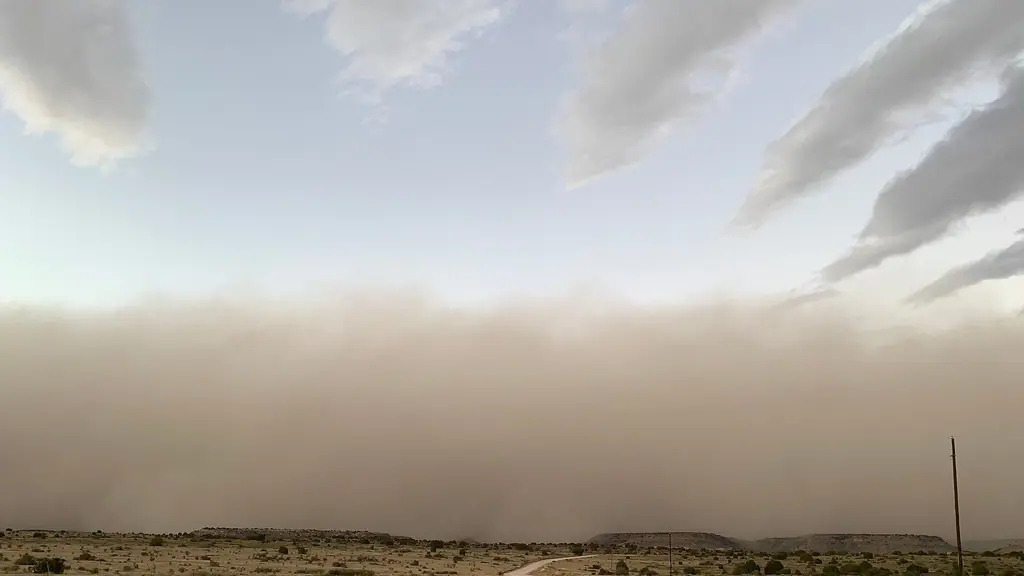
A wall of brown cloud rolls across the horizon, the sky turns orange and visibility drops to a few hundred metres. Sand and dust storms are among the most dramatic weather events on Earth, and they go by many local names, including the sirocco, the haboob and yellow dust. But their effects reach far beyond the moment of the storm, and far beyond the deserts where most of them begin.
This explainer covers what sand and dust storms are, where they come from, how they affect people and ecosystems, the human role in making them worse, and what can be done.
What sand and dust storms are
Sand and dust storms (often abbreviated SDS) occur when strong winds lift sand and dust from dry, bare soils into the atmosphere. Fine dust particles can be carried high into the atmosphere and transported thousands of kilometres across continents and oceans, according to the World Meteorological Organization (WMO).
The scale is enormous. In its 2025 Airborne Dust Bulletin, WMO estimated that around 2,000 million tonnes of sand and dust enter the atmosphere every year. More than 80% of the global dust budget originates from the deserts of North Africa and the Middle East.
Where dust comes from
The largest dust sources are concentrated in arid and semi-arid regions, especially the Sahara, the Gobi and the Arabian Desert. Natural sources include deserts, dried lake beds and coastal areas with loose sediment. In 2024, WMO reported the highest annual mean surface dust concentration in Chad, home to the Bodélé Depression, one of the world's key dust sources.
Dust does not stay local. WMO lists the regions most exposed to long-range dust transport as including the tropical North Atlantic between West Africa and the Caribbean, South America, the Mediterranean, the Arabian Sea, the Bay of Bengal and central-eastern China. Saharan dust regularly crosses the Atlantic to the Caribbean, and a Saharan dust intrusion into the European Alps in March 2022 contributed to that year's record glacier loss.
The human factor
Sand and dust storms are a natural phenomenon, but human activity is making them more frequent and intense in many places. The UNCCD states that at least 25% of global dust emissions originate from human activities, and that in some areas desert dust doubled during the 20th century.
The main human drivers are:
- Poor land management. Construction, agriculture and land management that strip vegetation expose soil to wind erosion, according to WMO.
- Poor water management. The drying of lakes and wetlands, often through over-abstraction for irrigation, exposes fine sediments. The UNCCD has highlighted the dried bed of the Aral Sea in Central Asia as a major source, emitting more than 100 million tonnes of dust and toxic salts every year.
- Drought and climate change. The UNCCD lists drought and climate change alongside poor land and water management as factors exacerbating sand and dust storms. Its 2024 aridity report linked rising aridity in the Middle East to more frequent and larger storms in the region.
The IPCC's chapter on desertification concluded with high confidence that unsustainable land management, particularly when coupled with droughts, has contributed to higher dust-storm activity, and that vegetation loss and drying of surface cover due to desertification increase the frequency of dust storms. This makes sand and dust storms one of the most visible consequences of desertification.
Impacts on health
Fine dust particles can be inhaled deep into the lungs. WMO's 2025 bulletin estimated that sand and dust storms affect about 330 million people in more than 150 countries.
A sand and dust storm indicator developed by WMO and the World Health Organization found that 3.8 billion people, nearly half the world's population, were exposed to dust levels exceeding the WHO safety threshold between 2018 and 2022. That was a 31% increase from 2.9 billion people during 2003–2007. In the most dust-prone regions, exposure occurred on more than 87% of days.
The IPCC cited an estimate that dust storms were associated with about 402,000 cardiopulmonary deaths globally in 2005. In areas where dust mixes with local industrial pollution, impacts on respiratory health can be worse, according to the UNCCD.
Impacts on farming, transport and energy
Agriculture. In source areas, sand and dust storms damage crops, affect livestock and strip fertile topsoil, according to the UNCCD. Figures cited by the UNCCD from FAO suggest such storms can cut crop yields by up to 25% in hard-hit regions.
Transport. Poor visibility closes roads and airports. WMO recorded an exceptional winter dust storm in December 2024 that struck Iraq, Kuwait, Qatar and the Arabian Peninsula, causing flight cancellations and widespread school closures.
Energy. WMO notes that dust storms can disrupt solar energy production, and the IPCC found with high confidence that more intense sand storms and moving dunes are damaging transport and solar and wind energy infrastructure.
Economy. The costs are large and often underestimated. WMO cited a study estimating that dust and wind erosion cost the United States about US$154 billion in 2017, more than four times a 1995 estimate. The UNCCD cites World Bank calculations that global welfare losses from dust rose from US$2.2 trillion in 1990 to about US$3.6 trillion in 2013.
Not all bad: dust as fertiliser
Dust also plays a natural role. Nutrients carried in mineral dust fertilise marine and land ecosystems far from source regions, benefiting fisheries and agriculture, as WMO notes. Dust is also a major component of atmospheric aerosols and influences weather through cloud formation and rainfall. The aim of policy is therefore not to eliminate dust but to reduce the human-driven increase and protect people from its harms.
Monitoring, forecasting and early warning
Forecasts and early warnings give people, airports and health services time to prepare. WMO's Sand and Dust Storm Warning Advisory and Assessment System, set up in 2007, coordinates forecasting through regional centres serving Northern Africa, the Middle East and Europe (Barcelona), Asia (Beijing), the Americas (Bridgetown) and the Gulf Cooperation Council region (Jeddah). WMO also publishes an annual Airborne Dust Bulletin. Dust warnings are part of the UN's Early Warnings for All initiative, which aims to cover everyone on Earth with early warning systems by the end of 2027.
Reducing the problem at source
Since much of the human contribution comes from degraded land and mismanaged water, the long-term solutions lie in better land and water management. The IPCC's Summary for Policymakers found with high confidence that reducing dust and sand storms and sand dune movement can lessen the effects of wind erosion and improve air quality and health. Depending on water availability and soils, windbreaks such as "green walls" using native and climate-resilient tree species with low water needs can reduce sand storms and wind erosion while improving soils and microclimates.
Because WMO identifies construction, agriculture and land management that strip vegetation as aggravating factors, measures that keep soils vegetated and protected, from sustainable grazing to dust control on construction sites, tackle the problem at source. Many are core elements of sustainable land management and soil conservation. The UNCCD, FAO and partners have produced a Sand and Dust Storms Compendium and online toolbox covering source mapping, monitoring, impact mitigation and preparedness.
Global cooperation
Dust crosses borders, so cooperation matters. The UN Coalition on Combating Sand and Dust Storms brings together more than 20 UN agencies and other bodies, including WMO, UNCCD, FAO, UNEP, WHO and the World Bank. The UN General Assembly proclaimed 12 July as the International Day of Combating Sand and Dust Storms and declared 2025–2034 the UN Decade on Combating Sand and Dust Storms.
Key takeaways
- Around 2 billion tonnes of sand and dust enter the atmosphere every year, mostly from North Africa and the Middle East.
- At least 25% of global dust emissions come from human activities, through poor land and water management.
- WMO estimates sand and dust storms affect about 330 million people in more than 150 countries; 3.8 billion people were exposed to unsafe dust levels in 2018–2022.
- Impacts include respiratory illness, crop losses, transport disruption and reduced solar energy output.
- Early warning reduces harm, while sustainable land and water management tackles the human-driven share at source.
Frequently asked questions
Are sand and dust storms getting worse?
In some regions, yes. The UNCCD reports that storms have become dramatically more frequent in some places and that desert dust doubled in some areas during the 20th century. Trends vary by region and year; WMO found that the global average dust concentration in 2024 was slightly lower than in 2023, with large regional differences.
Why does Saharan dust matter in the Caribbean?
Fine dust lifted over the Sahara can be carried thousands of kilometres across the Atlantic. WMO lists the tropical North Atlantic between West Africa and the Caribbean among the regions most exposed to long-range dust transport, with effects on air quality and daily life.
How can people protect themselves during a dust storm?
Follow warnings and advice from local meteorological and health authorities, which issue specific guidance during dust events.
Sources
- Sand and dust storms WMO, n.d.
- WMO highlights hotspots, health hazards and economic cost of sand and dust storms WMO, 2025
- Sand and dust storms UNCCD, n.d.
- Sand and dust storm frequency increasing in many world regions, UN warns UNCCD, 2023
- Chapter 3: Desertification. In: Climate Change and Land, IPCC Special Report IPCC / Cambridge University Press, 2019
- Summary for Policymakers. In: Climate Change and Land, IPCC Special Report IPCC / Cambridge University Press, 2019
- Three-quarters of Earth's land became permanently drier in last three decades: UN UNCCD, 2024
How this article was made: researched and drafted with the help of AI tools, then checked against the sources listed above. Read our editorial policy. Spotted an error? Tell us.