Soil is easy to overlook because it is underfoot. Yet it is one of the most valuable and least renewable resources on the planet. FAO notes that soils produce more than 95% of the food we eat, as well as storing and filtering water and regulating the climate. Soils also host about a quarter of the planet's biodiversity, according to FAO. Topsoil, the thin, fertile upper layer, forms extremely slowly: an FAO official has noted that a single centimetre can take up to 1,000 years to form, but can be washed away by one heavy rainfall if the ground is unprotected.
Soil conservation is the set of practices that keep soil in place and in good health. This guide looks at why soil is being lost, what the latest global assessment says, and which practices have the strongest track record.
Erosion: the biggest threat to soil
Soils face many threats, including salinisation, compaction, nutrient imbalance, contamination and loss of organic matter. But erosion stands out. In August 2026, FAO's Status of the World's Soil Resources 2026 report identified soil erosion as the most severe and interconnected threat to soil health. Across the seven regions assessed, 81% of assessments judged erosion management to be poor or very poor, and 65% reported a deteriorating trend since 2015.
Erosion is the removal of topsoil by water, wind or farming activities such as intensive tillage. Some erosion is natural and happens everywhere. The problem is the acceleration caused by human land use. FAO says unsustainable activities such as overgrazing, intensive agriculture and deforestation can increase erosion rates by up to 1,000 times.
The IPCC's 2019 Special Report on Climate Change and Land put the gap between loss and formation in stark terms. It estimated that soil erosion from agricultural fields is currently 10 to 20 times higher than the rate of soil formation under no-till systems, and more than 100 times higher under conventional tillage.
Why erosion matters
- Lower yields. By removing nutrients and rooting space, erosion can cut crop yields by up to 50% in affected areas, according to FAO. At a global scale, FAO has warned that erosion could reduce crop yields by up to 10% by 2050 if it is not tackled.
- Water problems. Eroded soils hold and filter less water. Sediment washed off fields can fill reservoirs and clog rivers, while reduced infiltration can make floods more frequent and severe.
- Ecosystem and infrastructure damage. Loose soil makes floods, landslides and windstorms more damaging, affecting rural and urban infrastructure alike.
- Climate. Erosion strips away soil organic carbon. Keeping soil in place is part of protecting soil carbon.
In 2016, FAO reported that globally about 75 billion tonnes of soil are lost from arable land each year, and that a third of the world's soils are classed as degraded.
Principles of soil conservation
Almost all effective soil conservation rests on a few simple principles:
- Keep the soil covered. Bare soil is vulnerable to the impact of raindrops and to wind. Living plants, crop residues and mulch absorb that energy.
- Disturb the soil as little as possible. Tillage breaks up soil structure and exposes it to erosion and carbon loss.
- Slow down water. Water running downhill gathers speed and carrying power. Breaking slopes into shorter sections, or guiding water along the contour, reduces erosion.
- Break the wind. On open, dry land, barriers of trees or shrubs reduce wind speed at the soil surface.
- Feed the soil. Healthy soils rich in organic matter hold together better, absorb more water and resist erosion.
Practices with a strong track record
FAO's Voluntary Guidelines for Sustainable Soil Management, endorsed by the Global Soil Partnership in 2016, made minimising soil erosion by water and wind a top priority. They point to careful management of land-use change, such as deforestation or the conversion of grassland to cropland, alongside protective practices like mulching, no-till farming, terracing, windbreaks and riparian buffers. They also recommend year-round crop cover and building up soil organic matter.
On cropland
- Cover crops and mulching. Growing plants between main crops, or leaving residues on the surface, protects soil and adds organic matter.
- Reduced or no tillage. Planting directly into the residue of the previous crop keeps soil structure intact. This is a core element of conservation agriculture.
- Crop diversification and rotation. Varied crops and rooting patterns improve soil structure and break pest cycles.
- Integrated nutrient management and organic amendments. Matching fertiliser and manure to crop needs maintains fertility without excess inputs.
On slopes
- Contour farming and contour ridges. Ploughing and planting across the slope rather than up and down it slows runoff.
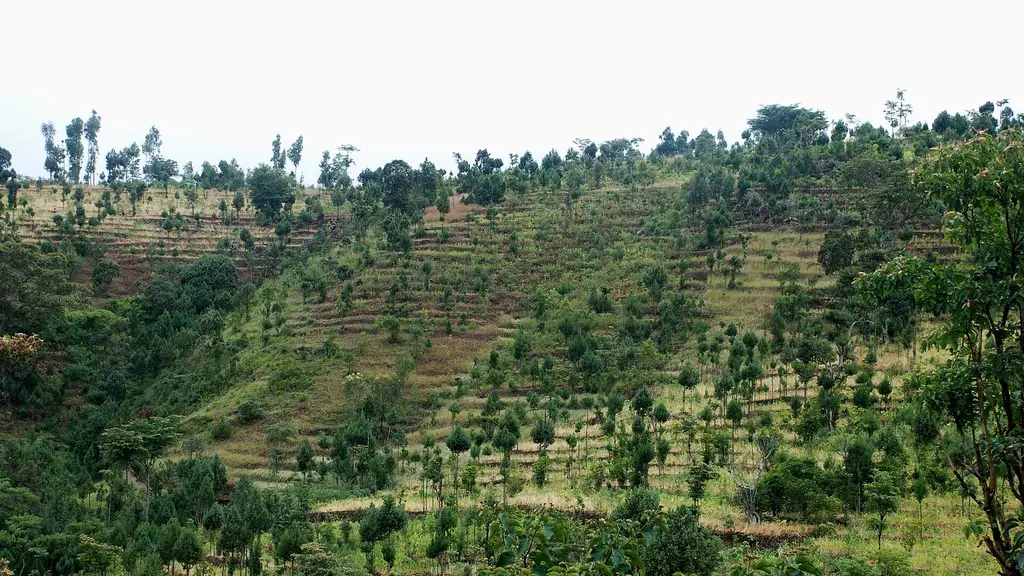
- Terraces. Building level steps into hillsides shortens slopes and slows runoff on steep land, though terraces take significant labour to build and maintain.
- Planting pits. In dryland farming, small pits concentrate water and organic matter around plants.
Trees, hedges and buffers
- Windbreaks and shelterbelts reduce wind erosion on open land.
- Riparian buffers, strips of vegetation along watercourses, trap sediment before it reaches streams.
- Agroforestry combines trees with crops or livestock, protecting soil while diversifying income.
On grazing land
The IPCC found with high confidence that rangeland management based on sustainable grazing and re-vegetation increases rangeland productivity. Managing stocking rates, resting pastures and maintaining plant cover all reduce erosion on grazing land. Our article on restoring rangelands covers this in detail.
The IPCC's chapter on desertification adds that integrated crop, soil and water management, including crop diversification, drought-resilient plants, reduced tillage, improved irrigation, rainwater harvesting and maintaining vegetation and mulch cover, can reduce soil degradation and increase resilience to climate change.
Evidence that it works: an example from Malawi
A national survey of cropland by FAO and the Government of Malawi, reported in 2016, found erosion hotspots where topsoil losses were associated with a 10% decline in farm output. But it also found "bright spots", for example in parts of the Rift Valley, where soil losses were much lower and had fallen over time thanks to active management. An FAO soils officer at the time attributed these bright spots to interventions such as mulching, minimal tillage, cover plants, contour ridges and planting pits. The study also found that soil loss had often increased where natural forests had been converted to farmland.
The adoption challenge
The practices above are not new. The difficulty is scale. FAO's 2026 global assessment found that more than half of the regional and subregional assessments reviewed showed low or very low adoption of sustainable soil management, and only around 10% reported improvement since 2015.
The report set out five priorities to speed up progress:
- strengthening soil governance and legal frameworks;
- promoting education, capacity development and knowledge exchange;
- improving soil monitoring through harmonised data, indicators and methods;
- strengthening incentives for adopting sustainable soil management;
- fostering inclusive, multidisciplinary and multi-stakeholder decision-making.
International cooperation on these issues is coordinated by FAO's Global Soil Partnership, established in 2012 to promote soil governance and sustainable soil management. It organises World Soil Day each year on 5 December; the 2026 theme focuses on tackling soil compaction to boost food production.
Soil conservation at home and at school
The same principles apply at small scale. Gardens, school grounds and allotments lose soil when beds are left bare, paths channel runoff or slopes are dug up and down rather than across. Mulching beds, planting ground cover, composting and avoiding unnecessary digging all help. A simple classroom demonstration compares how much muddy water runs off a tray of bare soil versus a tray covered with plants or mulch when watered gently; it needs only trays, soil and a watering can, with adult supervision for younger children. Our guide to soil and plant science basics offers more ideas.
Key takeaways
- Soil erosion is the most severe threat to soil health according to FAO's 2026 global assessment, with erosion management judged poor or very poor in 81% of regional assessments.
- Human activities can accelerate erosion by up to 1,000 times, and the IPCC estimates erosion from farmland far exceeds soil formation.
- Effective conservation rests on keeping soil covered, minimising disturbance, slowing water, breaking the wind and building organic matter.
- Proven practices include cover crops, mulching, reduced tillage, contour farming, terraces, windbreaks, riparian buffers and good grazing management.
- The main barrier is adoption, which depends on governance, incentives, knowledge and monitoring.
Frequently asked questions
Can lost topsoil be replaced?
Not on any practical human timescale. Soil forms very slowly, so conservation focuses on preventing loss. Adding compost and organic matter can improve the soil that remains, but it does not recreate lost topsoil.
Is no-till farming always better for soil?
Reduced or no tillage generally lowers erosion, and the IPCC's estimates show erosion rates far lower under no-till than conventional tillage. Results vary with local conditions, which is why reduced tillage is usually combined with soil cover and crop diversity.
What is the single most useful thing a farmer or gardener can do?
Keep the soil covered as much of the year as possible, with living plants or mulch. Cover is the first defence against both water and wind erosion.
Sources
- FAO at COP17: New report warns soil degradation worsening as adoption of proven solutions lags FAO, 2026
- Let's #StopSoilErosion to ensure a food secure future FAO, 2019
- Global Soil Partnership endorses guidelines on sustainable soil management FAO, 2016
- Soil erosion must be stopped 'to save our future', says UN agriculture agency UN News, 2019
- Summary for Policymakers. In: Climate Change and Land, IPCC Special Report IPCC / Cambridge University Press, 2019
- Chapter 3: Desertification. In: Climate Change and Land, IPCC Special Report IPCC / Cambridge University Press, 2019
- Global Soil Partnership FAO, 2026
How this article was made: researched and drafted with the help of AI tools, then checked against the sources listed above. Read our editorial policy. Spotted an error? Tell us.