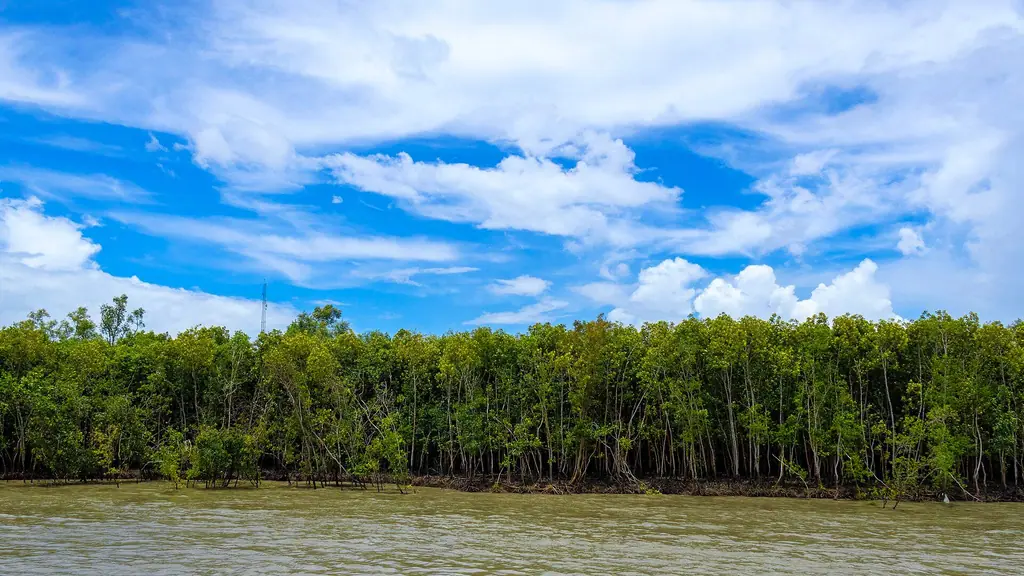
Mangroves are salt-tolerant trees and shrubs that grow where land meets sea along tropical, subtropical and some warm temperate coasts. Together with salt marshes and seagrass meadows, they form some of the most valuable and most threatened ecosystems on Earth. They buffer shorelines against storms, support coastal fisheries and store large amounts of carbon.
They are also among the most frequently "restored" ecosystems, and among the most frequently failed restoration projects. This article sets out what is known about mangrove loss, why coastal ecosystems matter, and what the evidence says about restoring them well.
How much mangrove is left
FAO's assessment The World's Mangroves 2000–2020, released in July 2023, put the global mangrove area in 2020 at about 14.8 million hectares, found along the coastlines of 123 countries. Asia holds almost half of the total.
Between 2000 and 2020, about 677,000 hectares of mangroves were lost. Some 393,000 hectares of new mangrove grew in places where none existed in 2000, offsetting more than half of that loss. According to FAO, the rate of loss slowed in the second decade compared with the first.
The causes of loss are revealing. FAO found that pond shrimp aquaculture caused 31 per cent of loss in 2000–2010, falling to 21 per cent in 2010–2020. Natural retraction accounted for 26 per cent over the two decades. On the gain side, FAO attributed 82 per cent to natural expansion and 18 per cent to restoration. In other words, most new mangrove appeared without planting.
A global risk assessment
In May 2024, IUCN published the first global assessment of mangroves under its Red List of Ecosystems. More than 250 experts from 44 countries divided the world's mangroves into 36 regional provinces and assessed each one.
The results were stark:
- 50 per cent of the mangrove ecosystems assessed were classed as Vulnerable, Endangered or Critically Endangered, meaning at risk of collapse.
- Nearly 20 per cent were at high risk (Endangered or Critically Endangered).
- Climate change threatened about a third of the ecosystems assessed, through sea-level rise and more frequent severe storms, on top of deforestation, development, pollution and dam building.
IUCN estimated that, without significant changes, losses by 2050 could release about 1.8 billion tonnes of stored carbon, around 17 per cent of the current mangrove carbon stock. It also estimated that 2.1 million people would lose protection from coastal flooding.
The State of the World's Mangroves 2024 report from the Global Mangrove Alliance, a coalition of more than 100 organisations, adds that Southeast Asia holds about a third of the world's mangroves, with Indonesia alone home to about 21 per cent.
Why coastal ecosystems matter
Coastal protection
The IPCC's Sixth Assessment Report on impacts and adaptation concludes with high confidence that coastal wetlands protect against coastal erosion and flooding associated with storms and sea-level rise, where there is enough space and suitable habitat. This is one of the clearest examples of ecosystem-based adaptation.
Carbon storage
Coastal wetlands are part of what is often called "blue carbon". The IPCC's mitigation report estimates that the conservation, improved management and restoration of forests and other ecosystems, explicitly including coastal wetlands and peatlands, offer the largest share of the land sector's economic mitigation potential, at 4.2–7.4 billion tonnes of CO₂-equivalent a year between 2020 and 2050.
The IPCC's Special Report on Climate Change and Land makes a point that matters for planning: conserving high-carbon ecosystems such as mangroves has immediate benefits, while restoring them takes longer to deliver. Protecting the mangroves that remain is therefore the first priority.
Fisheries and livelihoods
IUCN's 2024 assessment estimated that the mangrove losses expected by 2050 would remove about 17 million days of fishing effort a year, around 14 per cent of the fishing currently supported by mangroves. Coastal communities depend on mangroves for fish, crabs, shellfish, timber and fuel, which is why their involvement is central to any restoration plan.
Why so many mangrove projects fail
Mangrove planting is attractive partly because its results seem easy to count. But the number of seedlings planted says little about whether a forest will grow.
A detailed study of mangrove planting in Sri Lanka, much of it carried out after the 2004 Indian Ocean tsunami, illustrates the problem. Researchers surveyed 23 project sites covering about 1,000–1,200 hectares and 67 separate planting efforts. Only about 200–220 hectares showed successful restoration. Nine of the 23 sites had no surviving plants, and survival ranged from 0 to 78 per cent (Kodikara et al., 2017).
The authors identified several recurring causes:
- Wrong elevation. Seedlings were often planted at the wrong position in the tidal frame, which meant unsuitable soil and flooding conditions.
- Poor hydrology. Sites with inappropriate topography and water flow suffered more stress.
- No aftercare. Survival was significantly correlated with post-planting care.
- Grazing and other pressures. Cattle trampling, browsing, algal build-up and insect attack were common.
The study concluded that the stated aims of restoration projects often do not match outcomes on the ground.
What good mangrove restoration looks like
The ten principles for ecosystem restoration published by FAO, IUCN CEM and SER in 2021 apply directly to coasts. Translated into mangrove terms, they suggest the following.
Start with the cause of loss
If mangroves disappeared because ponds were dug, roads blocked tidal channels or freshwater was diverted upstream, replanting without fixing those problems is unlikely to work. The principles call for addressing the direct and indirect causes of degradation before and during restoration.
Restore the water first
Mangroves grow where the frequency and duration of tidal flooding suit them. The Sri Lankan evidence shows that getting elevation and water flow right is decisive. In many places, reopening tidal connections or removing abandoned pond walls allows mangroves to return naturally, which is consistent with FAO's finding that most recent mangrove gain came from natural expansion.
Plant only where needed, and use the right species
Where planting is necessary, the principles favour genetically appropriate native species and warn against species that are, or could become, invasive. Because restoration is judged by its net gain for biodiversity, planting mangroves on open mudflats or other habitats where they did not previously grow does not meet the definition simply because trees are added.
Involve coastal communities from the start
Fishers, aquaculture farmers and landholders decide what happens to a coast long after a project ends. The principles call for inclusive governance, secure tenure and fair sharing of benefits. Projects that leave out the people who use the land and water rarely last.
Monitor survival, not planting
Measurable goals and long-term monitoring (principles 7 and 9) are critical. Useful indicators include survival after several years, canopy cover, natural recruitment of seedlings, and the return of fish and invertebrates, rather than the number of seedlings put in the ground.
Leave room to move
The IPCC's finding on coastal protection comes with a condition: wetlands protect coasts where there is sufficient space and adequate habitat. As sea levels rise, keeping undeveloped land behind existing mangroves and marshes gives them room to adjust, and is a form of restoration planned in advance.
Beyond mangroves
Mangroves often receive most attention, but salt marshes and seagrass meadows are also part of the coastal wetland picture. Restoring them follows the same logic: understand why they declined, repair water and sediment flows, protect them from renewed damage and monitor results. For the bigger picture, see our guide to the principles of ecosystem restoration and our article on wetlands and peatlands, which covers the inland side of the wetland story. More on the wider landscape context is available in our biodiversity topic hub.
Key takeaways
- The world had about 14.8 million hectares of mangroves in 2020, according to FAO, and losses slowed in 2010–2020 compared with the previous decade.
- IUCN's 2024 assessment found half of the world's mangrove ecosystems at risk of collapse, with climate change an increasing threat.
- Coastal wetlands protect shorelines, store carbon and support fisheries; protecting existing mangroves delivers benefits faster than restoring lost ones.
- Many planting projects fail because of wrong elevation, blocked water flow, lack of aftercare and weak community involvement.
- Successful restoration repairs hydrology first, relies on natural regeneration where possible and measures survival over years, not seedlings planted.
Frequently asked questions
Is planting mangroves always a good idea?
No. Planting in places where mangroves never grew, at the wrong tidal elevation, or without fixing blocked water flow often fails. Where conditions are right, mangroves frequently regenerate naturally once pressures are removed.
How quickly do restored mangroves store carbon?
It varies widely by site and species. The IPCC notes that restoring high-carbon ecosystems takes longer to deliver benefits than conserving existing ones, which is why protecting remaining mangroves is the priority.
Who should lead mangrove restoration?
Restoration works best when local communities, landholders and government agencies plan it together, with technical support on hydrology and ecology and a commitment to long-term monitoring.
Sources
- Global effort to safeguard mangroves steps up: rate of loss has slowed in the last decade, new FAO report says FAO, 2023
- More than half of all mangrove ecosystems at risk of collapse by 2050 – first global assessment IUCN, 2024
- New State of the World's Mangroves report underscores critical links between biodiversity, climate and people IUCN / Global Mangrove Alliance, 2024
- Have mangrove restoration projects worked? An in-depth study in Sri Lanka (Kodikara et al., Restoration Ecology 25(5)) Society for Ecological Restoration / Wiley, 2017
- Climate Change 2022: Impacts, Adaptation and Vulnerability. Summary for Policymakers IPCC, 2022
- Climate Change 2022: Mitigation of Climate Change. Summary for Policymakers IPCC, 2022
- Climate Change and Land: Summary for Policymakers IPCC, 2019
- Principles for ecosystem restoration to guide the United Nations Decade 2021–2030 FAO, IUCN CEM and SER, 2021
How this article was made: researched and drafted with the help of AI tools, then checked against the sources listed above. Read our editorial policy. Spotted an error? Tell us.