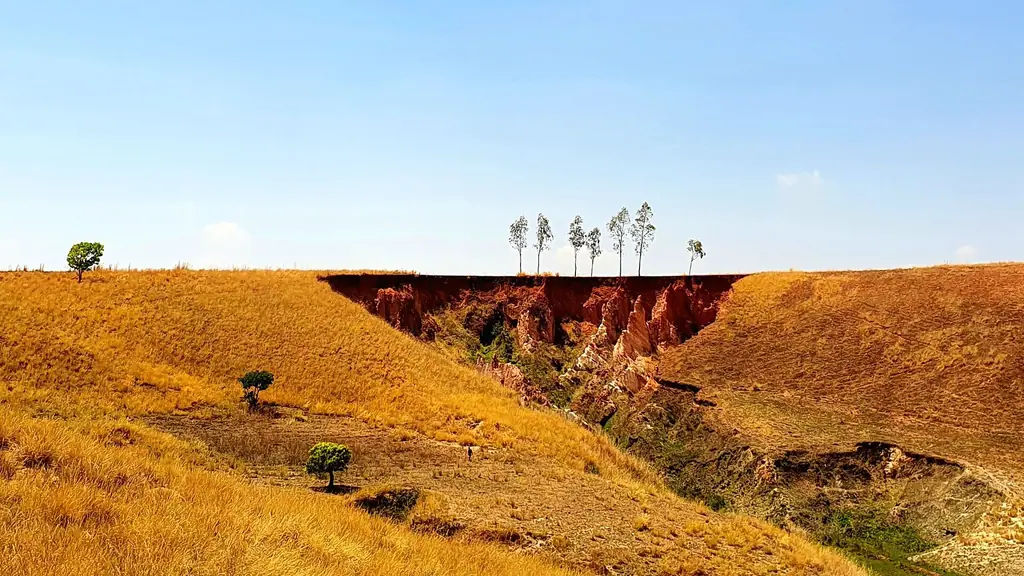
Land degradation is usually described in physical terms: eroded topsoil, falling yields, shrinking vegetation cover. Economics adds a different question. What does that loss cost the people who depend on the land, and the wider society that relies on its water, carbon and food? The answer shapes whether governments, lenders and businesses treat restoration as a cost to be minimised or an investment worth making.
This page explains how economists approach that question, what the main global estimates say, and where to find official guidance.
What the original page covered
In its 2016 form, this page described the former Global Mechanism's work on "economic valuation and financing". It argued that many businesses depend on land directly, through farming, forestry and mining, or indirectly through supply chains. It listed three areas of activity: helping countries and companies value natural capital and land-use change, showing examples of profitable restoration, and promoting new financial instruments in support of land degradation neutrality.
Some older links to a Global Mechanism PDF on the "cost of land degradation case studies" now point to this page. That document is a 2003 desk study by Len Berry, Jennifer Olson and David Campbell, commissioned by the Global Mechanism with World Bank support. It reviewed national data on the extent and cost of degradation in seven pilot countries: China, Ethiopia, Mexico, Uganda, Rwanda, Chile and Indonesia. Its authors found the cost data incomplete and inconsistent between countries. They also concluded that spending on remedies was much smaller than the estimated losses. The study is now mainly of historical interest; the newer assessments below use more consistent methods.
Why put a value on land?
Most of what healthy land provides never passes through a market. Farmers sell crops, but nobody is paid for the soil that holds water after rain, or for the vegetation that keeps dust out of the air. Because these benefits carry no price, they tend to be ignored when land-use decisions are made. Degradation then looks cheaper than it really is.
Economic valuation tries to correct this by estimating the value of those benefits. The usual framework is total economic value (TEV), which adds together:
- Direct use values: crops, livestock, timber, fuelwood and other products.
- Indirect use values: services such as water regulation, erosion control, pollination and carbon storage.
- Option values: keeping land productive for uses that may matter in future.
- Non-use values: the value people place on a landscape or species existing at all, even if they never use it.
The ELD Initiative's 6+1 step approach builds this into a practical method. Analysts define the study area, identify ecosystem services, estimate the total economic value of each one and map the pressures causing degradation. They then compare the costs and benefits of action against business as usual. The "+1" step is acting on the results.
The main global estimates
Three widely cited assessments have attempted global figures. They measure different things, so their numbers cannot be compared directly.
| Assessment | What it measures | Headline finding |
|---|---|---|
| ELD Initiative, The Value of Land (2015) | Lost value of ecosystem services | USD 6.3–10.6 trillion per year |
| Nkonya, Mirzabaev and von Braun (eds), 2016 | Land-use change and lower cropland and rangeland productivity | About USD 300 billion per year |
| IPBES land degradation assessment (2018) | Lost biodiversity and ecosystem services | More than 10% of annual global gross product |
The ELD Initiative's 2015 report puts global losses of ecosystem service value at USD 6.3–10.6 trillion a year. It also estimates that sustainable land management could raise crop production by up to USD 1.4 trillion.
The 2016 global assessment edited by Nkonya, Mirzabaev and von Braun uses a narrower definition and arrives at about USD 300 billion a year. Sub-Saharan Africa accounts for the largest regional share, at 22%. Land users bear only about 38% of the cost of land-use and land-cover change; the rest falls on people elsewhere who lose ecosystem services. On average, the authors found, each dollar invested in restoring degraded land returns about five dollars.
The IPBES summary for policymakers estimates that biodiversity and ecosystem services lost to degradation cost more than 10% of annual global gross product. It says human-caused degradation is harming the well-being of at least 3.2 billion people.
Reading the numbers carefully
The spread between these figures reflects choices about what to count, not disagreement about whether the problem is serious. Estimates that include only lost farm output are lower; estimates that include regulating services and biodiversity are much higher. The most robust shared finding is not any single figure. It is that the benefits of preventing degradation and restoring land generally exceed the costs.
From valuation to finance
Valuation matters because it changes who might pay. If most of the cost of degradation falls on people downstream or elsewhere, then land users alone have little incentive to invest in prevention. That gap is the rationale for instruments such as payments for ecosystem services, blended finance and dedicated funds. These try to reward land managers for benefits that others receive. Valuation studies also help ministries of finance compare land investments with other spending priorities.
The ELD Initiative, set up in 2011 by the UNCCD, Germany's Federal Ministry for Economic Cooperation and Development and the European Commission, and hosted by GIZ, remains active and publishes case studies and training material. For an overview of practical options, see our explainer on sustainable land management.
Key takeaways
- Economic valuation estimates the benefits healthy land provides, including the many that never pass through a market.
- Total economic value combines direct use, indirect use, option and non-use values.
- Global estimates range from about USD 300 billion to over USD 10 trillion a year, depending on what is counted.
- Major assessments agree that restoring degraded land usually yields more than it costs.
- Because most costs fall on people other than land users, finance instruments are needed to close the incentive gap.
Sources
- The Value of Land: Prosperous Lands and Positive Rewards through Sustainable Land Management ELD Initiative (via UNCCD Library), 2015
- Economics of Land Degradation and Improvement – A Global Assessment for Sustainable Development Nkonya, Mirzabaev and von Braun (eds), via UNCCD Library, 2016
- Summary for policymakers of the assessment report on land degradation and restoration IPBES (via UNCCD Library), 2018
- Economics of Land Degradation (ELD) Initiative ELD Initiative, 2026
- ELD 6+1 Step Approach ELD Initiative, 2026
- Assessing the Extent, Cost and Impact of Land Degradation at the National Level: Findings and Lessons Learned from Seven Pilot Case Studies (bibliographic record) BibBase, 2003
How this article was made: researched and drafted with the help of AI tools, then checked against the sources listed above. Read our editorial policy. Spotted an error? Tell us.