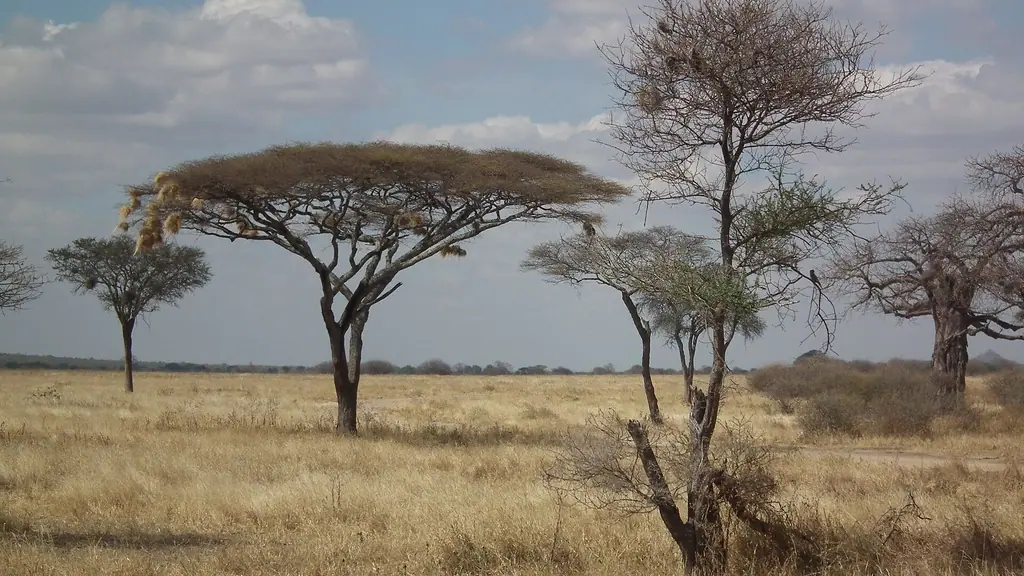
Drylands are often pictured as empty places with few trees. That picture is wrong. Satellite surveys over the past decade have shown that drylands contain large areas of forest and many more scattered trees on farms and pastures. For households in these regions, trees are a source of food, livestock fodder, fuel and cash, and a buffer when harvests fail.
The original article at this address, as its title indicates, presented dryland forests as a key to increased food security. Because its text was not archived, this page does not attempt to reconstruct it. Instead it explains the topic using current sources.
How much forest is in the drylands?
In July 2016 the Food and Agriculture Organization of the UN (FAO) released preliminary findings from the first global assessment of trees, forests and land use in drylands. The study used freely available satellite imagery to examine more than 200,000 sample plots of roughly half a hectare each. Its main findings were:
- The world's drylands cover about 6.1 billion hectares and are home to an estimated 2 billion people, 90% of them in developing countries.
- Drylands contain 1.11 billion hectares of forest, which is 27% of the world's forest area.
- Forest covers almost 18% of the dryland area.
- Trees outside forests are present on 1.9 billion hectares of drylands, or 31% of the total, if any crown cover is counted.
- Thirty percent of croplands and grasslands have at least some tree cover.
The full report followed in 2019. It describes drylands as productive landscapes with real economic potential rather than wastelands.
A related peer-reviewed paper by Bastin and colleagues in Science (2017) used the same sampling approach. It estimated that 1,079 million hectares of dryland was forest in 2015, which is 40–47% more than earlier estimates. That raised estimates of global forest cover by at least 9%.
How dryland trees support food security
Food security is usually described in four dimensions: availability, access, utilisation and stability. FAO's guidance on forests, food security and nutrition shows how trees contribute to each.
Food and nutrition
Wild fruits, leaves, seeds, nuts and honey gathered from forests and farm trees add micronutrients to diets that are often based on a few staple grains. FAO classes these as non-wood forest products, defined as goods of biological origin, other than wood, from forests, other wooded land and trees outside forests. In the Sahel, for example, gum arabic from Acacia senegal is both a traded product and a source of income for the communities that harvest it, as an FAO restoration story from Mauritania describes.
Fodder for livestock
Livestock keeping is central to dryland livelihoods. When grasses dry out, the leaves and pods of trees and shrubs can be one of the few remaining feed sources. In the same Mauritanian restoration plots, residents use the planted vegetation as fodder for cattle in the lean season. This links trees directly to milk and meat supply. See our explainer on rangeland restoration for more on pastoral systems.
Income and access
Selling fuelwood, gum, fruit or honey gives households cash to buy food. FAO's 2016 drylands release notes that wood can be an income source for poor households.
Stability in bad years
Trees are more drought-tolerant than annual crops. When harvests fail, tree products and income from them act as a safety net. Trees on farms also shade soils, reduce wind erosion and add organic matter. These are the principles behind agroforestry and farmer-managed natural regeneration.
Threats and policy attention
FAO's dryland forestry programme warns that large areas of drylands are degraded or at high risk of further degradation, with environmental and social consequences. Dryland forests have also been poorly documented. The finding by Bastin and colleagues that several hundred million hectares of dryland forest had never been reported shows how easily sparse tree cover was overlooked in earlier statistics.
That has begun to change. At its 22nd session in 2014, FAO's Committee on Forestry (COFO) set up a Working Group on Dryland Forests and Agrosilvopastoral Systems. Its mandate is to report on the status and trends of these systems and to promote good practice in their protection, management and restoration. Its third session took place in Jordan in September 2023 and its fourth in Ulaanbaatar, Mongolia, in July 2025.
For the broader picture of how climate pressures affect food systems, see food security and climate change.
Key takeaways
- FAO's 2016 assessment found 1.11 billion hectares of forest in drylands, about 27% of the global forest area.
- Trees outside forests occur on 1.9 billion hectares of drylands, including many farms and pastures.
- Dryland trees provide food, fodder, fuel and income, and act as a safety net in drought years.
- Dryland forests have historically been under-studied and under-funded, but now have a dedicated FAO working group.
Sources
- FAO study provides the most detailed snapshot to date on trees, forests and land use in the world's drylands FAO, 2016
- Trees, forests and land use in drylands: The first global assessment FAO (via UNCCD Library), 2019
- The extent of forest in dryland biomes Science (Bastin et al.), 2017
- Dryland forests and agrosilvopastoral systems FAO, 2026
- COFO Working Group on Dryland Forests and Agrosilvopastoral Systems FAO, 2025
- Forests, food security and nutrition: basic knowledge FAO Sustainable Forest Management Toolbox, 2026
- Non-wood forest products FAO, 2026
- Giving back to the desert in Mauritania FAO, 2024
How this article was made: researched and drafted with the help of AI tools, then checked against the sources listed above. Read our editorial policy. Spotted an error? Tell us.